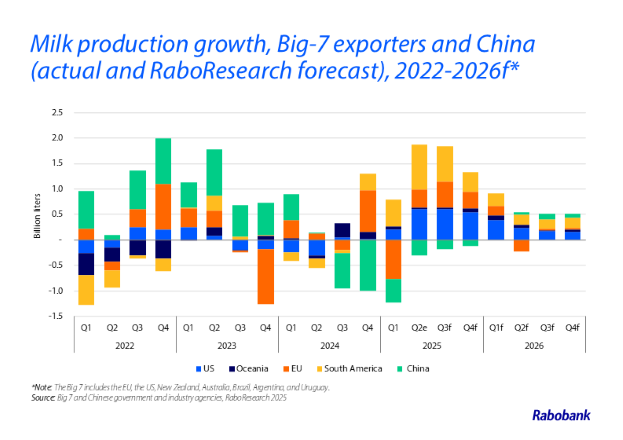
According to a new RaboResearch report, global milk supply is on the rise across key dairy export regions. While milk production is increasing, demand remains sluggish, leading to a growing exportable surplus that could put downward pressure on dairy commodity prices into early 2026.
Milk supply growth in the Big 7 dairy exporting regions is expected to increase by 1.8% year-on-year in the second half of 2025, before slowing to 1.1% year-on-year in 2026. This growth is driven by improving farm margins, recovery from last year’s disease outbreaks, and favourable weather conditions. In the US, milk production posted its strongest growth rate since 2021 (+3.4% year-on-year), while New Zealand experienced a record start to its new season.
Despite the increase in supply, the global dairy markets face headwinds on the demand side, particularly among low- and middle-income consumers, says Mary Ledman, Global Dairy Strategist at RaboResearch: “Weak consumer confidence continues to weigh on discretionary spending. The ongoing sluggish demand is evident across many foodservice channels. Dairy demand in grocery channels is also underwhelming in many countries. Households are paying more for dairy products, as inflation in dairy aisles is rising in some regions.”
“China is still battling a consumption slump, and recovery signals in Southeast Asia are mixed. In the US, concerns around the labour market and the impact of tariffs are weighing on consumer confidence. We need a boost in consumer sentiment to support a meaningful recovery in dairy demand.”
Continued Ledman: “Progress has been made on the trade front, with several trade deals concluded. The US and China have agreed to extend their trade truce, and the EU is working on new dairy import quotas. These are promising steps, but it’s still unclear how much they’ll actually influence global dairy trade. Meanwhile, La Niña could affect Southern Hemisphere milk production, with too much rain in Australia and too little in South America.
“Going forward, the global market appears well supplied. If demand picks up gradually, it should be enough to counter the volume without overwhelming the market, although we could still see some downside pressure on prices in the short term.” For more visit Rabobank.com