It is impossible to imagine a factory without data — the system architecture is simply too complex. The question is: How must manufacturing IT be structured to ensure efficient data processing in food production?
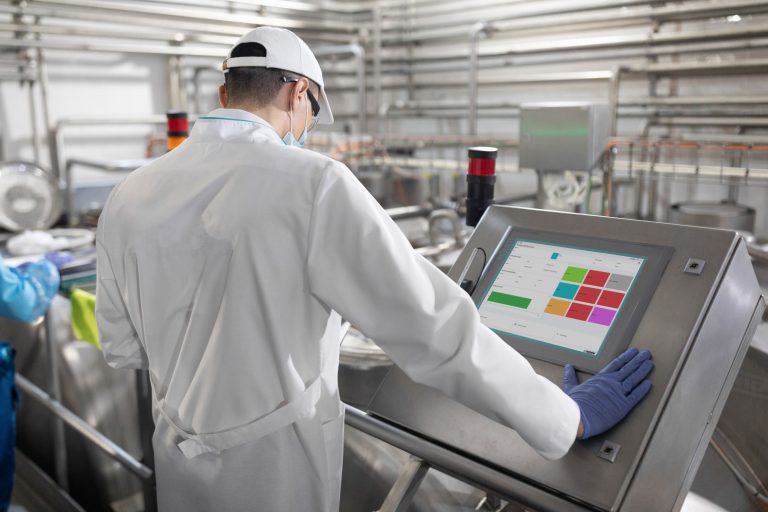
It is 5 am at a dairy somewhere in southern Germany. The first trucks carrying fresh milk are arriving while the machines are humming in the production hall. An employee in the control room concentrates on several monitors: one of them shows real-time data of incoming raw material, another monitors the temperature of the pasteurization process.
In the background, the filling machines are running, and the shift supervisor checks on the tablet whether all systems are ready for production to start. With one click, the supervisor launches the production order for 20,000 liters of fresh milk. The system automatically distributes the work instructions to the machines, controls the assignment of batches, and coordinates the cleaning of tanks between production steps. At the same time, quality data and process parameters are seamlessly recorded and centrally documented.
The entire process runs like a well-rehearsed orchestra: from goods receipt and processing to packaging and delivery. Deviations are detected immediately enabling direct measures.
Many production facilities in the food industry operate in similar ways: the IT architecture coordinates processes in the background. But how should it be structured so everything runs like clockwork?
Increased networking
The automation pyramid has long been standard in the manufacturing environment — also in the food industry. However, it is becoming increasingly difficult to map new IT architectures with this pyramid. It is no longer possible to depict everything hierarchically, as in the automation pyramid.
Peter Hofmann, Manager Innovation at MPDV, explains: “A significant disadvantage of the pyramid structure is that only directly neighboring layers communicate with each other, which usually occurs in proprietary protocols. Nowadays, networking has increased significantly, for example to collect and evaluate quality data in real time in the food industry, and as a result this type of communication is no longer effective.” Headlines such as “The automation pyramid has had its day” were therefore frequently seen in the trade press.
From the pyramid to the honeycomb
For this reason, experts suggest that the pyramid should be replaced by a network where all participants can communicate with each other. The objective of non-hierarchical communication is thus achieved. However, a new challenge arises as the number of interfaces increases exponentially. If every system and every device can connect to others, the number of connections increases significantly with each new device added. To make things even more complicated, there is no standard protocol to be used everywhere. This means that, in particular in food production, where production lines need to be changed frequently and where machines of different manufacturers must communicate with each other, an increasing number of interfaces pose a big challenge. To deal with this, a central platform, a hub, is needed.
MPDV has been pursuing this path for years with the Manufacturing Integration Platform (MIP). Peter Hofmann points out: “The principle is simple yet ingenious: all systems and devices communicate with the MIP. Therefore, we only have one interface, which is a standardized interface.” If another system or device is to be connected, only a single additional interface is set up eliminating complexity.
A modern architectural model emerges
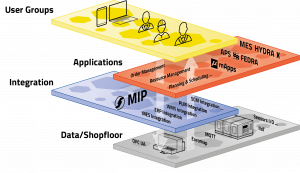
The MPDV experts opted for a multi-layered honeycomb structure inspired by bees to visually illustrate the model and its architecture. This kind of structure is also suitable for representing highly dynamic, regulated processes in the food industry: The compact design stands for a reduction of interfaces in manufacturing IT, which is a great advantage when it comes to customizations and traceability in the food segment. MPDV calls the new model “Smart Factory Hive”.
The hive is made up of four layers:
– Data/Shop floor: This is where all data suppliers are located, such as sensors for temperature monitoring, equipment for cleaning cycles, or systems for batch tracing. The data suppliers can also be aggregation platforms, such as systems based on the Industrial Internet of Things (IIoT).
– Integration: If data is to be processed, distributed, or analyzed, the integration platform ensures that everyone has the data they need and for which they are authorized.
– Applications: This layer is suitable for any type of application of the manufacturing IT, such as recipe management, batch tracing, or production planning.
– User Groups: The different user groups in the company are assigned to the top layer, from the machine operator to quality assurance and management. All users can access their applications and the data assigned to them.
All layers consist of a flexible honeycomb structure containing the different components of the layer. In each layer, different types of components are grouped together.
Rethinking data collection and processing
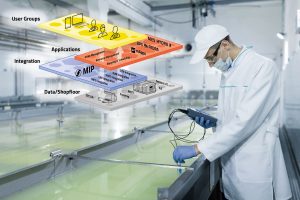
If we now consider the approach taken by the Smart Factory Hive, the example from the beginning changes in several places:
The first trucks deliver fresh milk to the dairy, the machines in the production hall are running, and the monitors display real-time data on raw material receipt and temperature data. So far, everything is the same. To display the data, it is recorded in the shop floor, but then transferred to the integration platform, the MIP. This is the integration layer in the model of the Smart Factory Hive. Applications of the application level obtain their information from the MIP and visualize it on screens.
In the background, the filling machines are running, and the shift supervisor (User Groups) checks on the tablet whether all systems are ready for production to start. With one click in the manufacturing IT, the supervisor launches the production order for 20,000 liters of fresh milk (Applications). The system automatically distributes the work instructions to the machines via the integration platform (Integration). It controls the assignment of batches and coordinates the time-critical cleaning of tanks between production steps. At the same time, quality data and process parameters are seamlessly recorded (Data/Shop Floor) and centrally documented (Integration).
In the Smart Factory Hive model, it is the integration platform, which ensures that all processes are running and are well organized: from goods receipt and processing to packaging and delivery, all processes are integrated and linked to each other as well as digitally monitored — without the need for a large number of interfaces.
Conclusion
A similar networking of data collection and the resulting activities can be specified for every type of order, event, or company. The process is always the same: the data collected is available for all applications on the integration platform. The Smart Factory Hive paves the way for the data from the shop floor to the user. The hierarchy of individual applications, barely visible today, becomes transparent. Users find their way around more easily.
The integration platform is therefore the central hub für targeted data distribution. Intelligent networking of machines, systems, and people is no longer a topic of the future, but already today the key to successful and future-proof food production.