
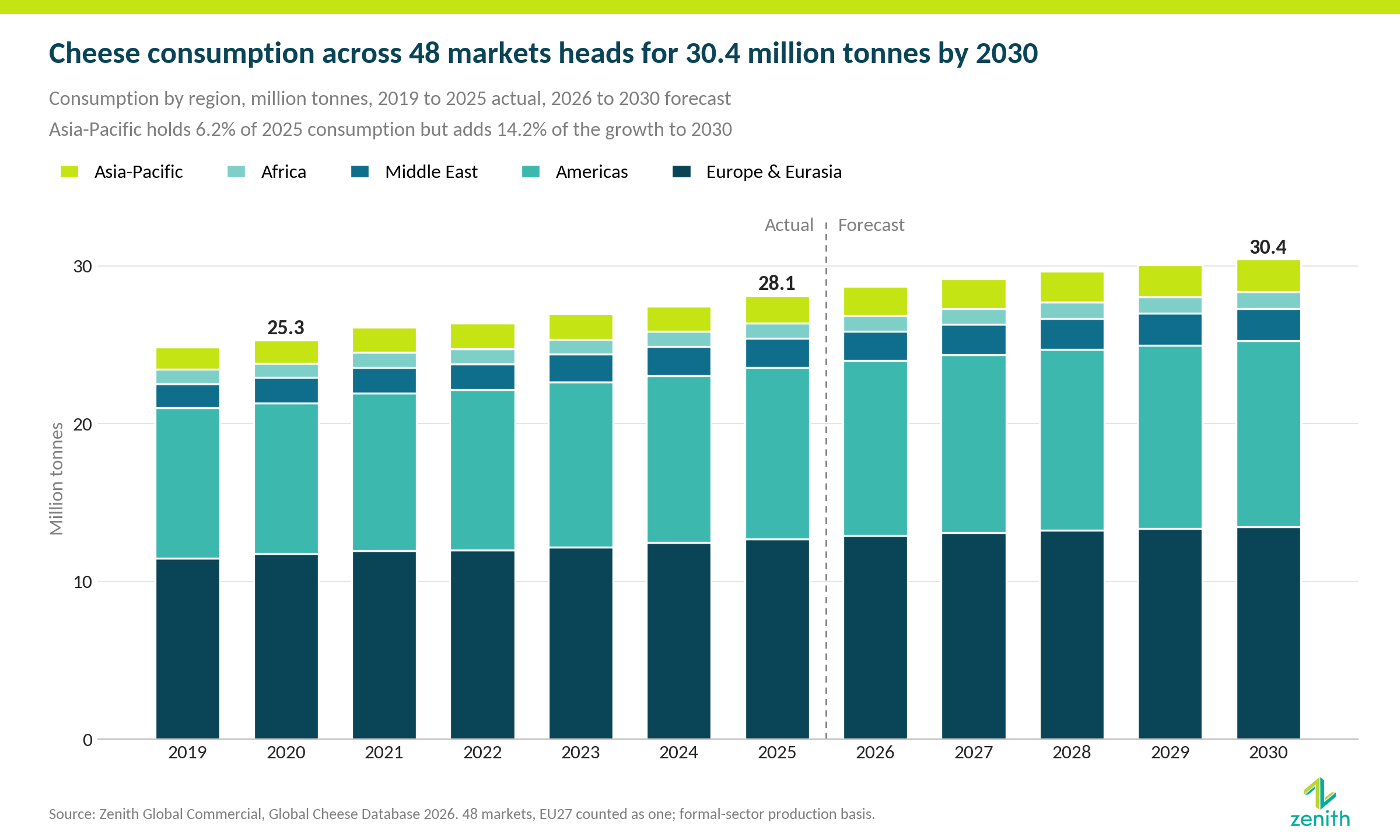
Cheese consumption across the 48 markets of the Global Cheese Database 2026 reached 28.1 million tonnes in 2025, up 2.4% on 2024, according to new data published today by Zenith Global Commercial. That is 4.78 kg per person, up from 4.40 kg in 2020. The database forecasts 30.4 million tonnes by 2030.
 Production reached 30.1 million tonnes in 2025. The European Union and the United States made 64.4% of it and ate 60.2% of the cheese consumed across the 48 markets. Exports exceeded imports by about 565,000 tonnes, the volume that flows to countries outside the database.
Consumer retail value, the retail share of consumption at regular shelf prices, reached USD 199.6 billion in 2025. In US dollars it rose 41.4% between 2020 and 2025, carried by volume, food price inflation and exchange rates together.
Per person consumption ranges from 0.11 kg a year in India to 23.11 kg in Switzerland. That gap is where the growth now comes from.
Growth to 2030 moves east
Consumption across the 48 markets grows by 2.3 million tonnes between 2025 and 2030, a compound rate of 1.60% a year. The European Union (+492,000 tonnes) and the United States (+487,000 tonnes) still add the most volume, together 42.3% of the new demand, followed by Russia, Mexico and Türkiye.
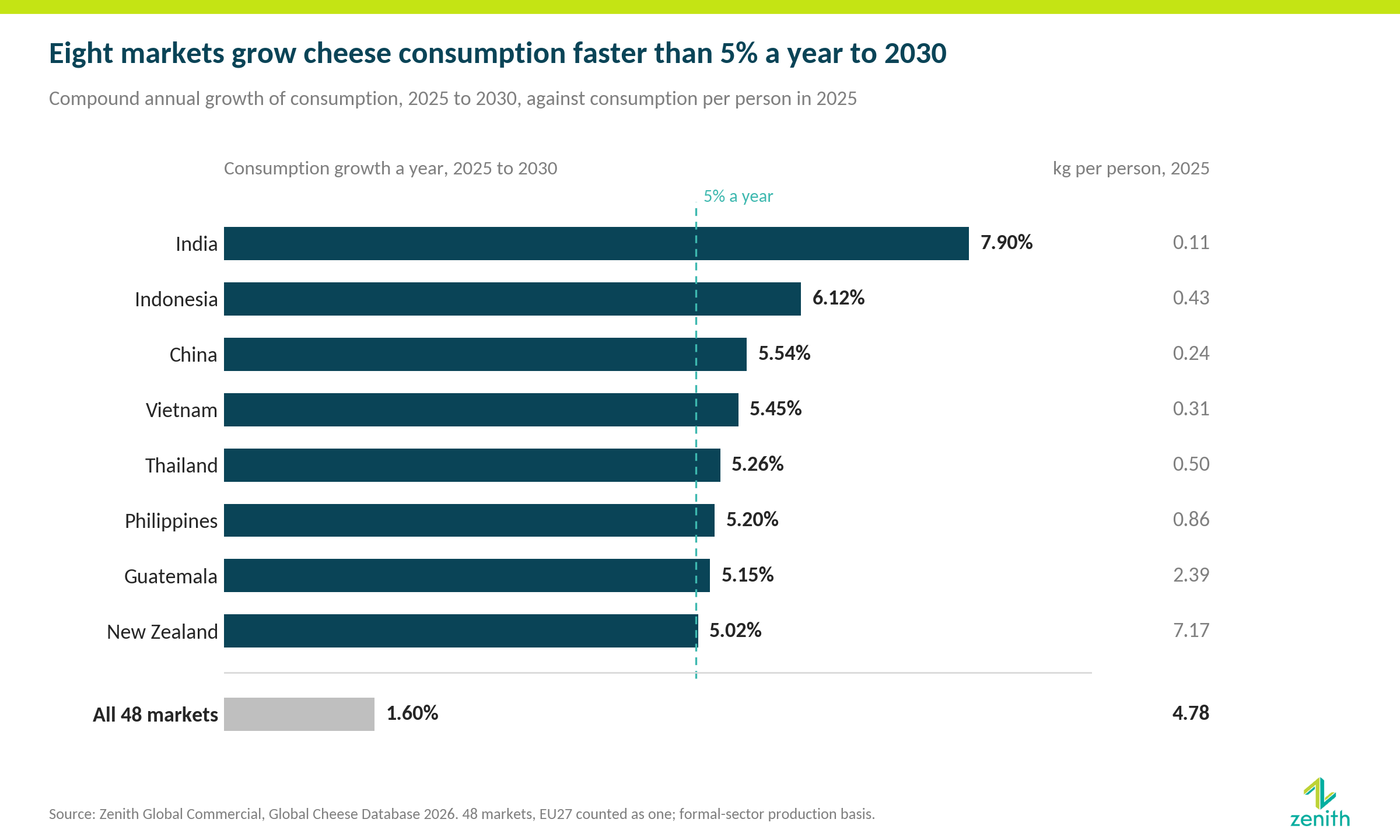
The fastest growth comes from markets where people eat little cheese today. India grows at 7.90% a year, followed by Indonesia, China, Vietnam and Thailand; eight markets in all grow faster than 5% a year. Asia-Pacific holds 6.2% of consumption across the database but adds 14.2% of its growth to 2030.
Imports grow faster than demand: 3.02% a year against 1.60% for consumption, reaching 4.0 million tonnes in 2030. Demand is rising fastest where domestic production is smallest. Japan is the only market in the database where consumption is lower in 2030 than in 2025.
Fresh cheese leads, processed cheese slows
 Fresh cheese, mozzarella included, is the largest category at 9.7 million tonnes, 34.5% of consumption, and the fastest growing at 2.39% a year to 2030. Hard and semi-hard cheese follows at 7.6 million tonnes, growing 1.22% a year. Processed cheese slows from 2.23% a year in 2020 to 2025 to 0.83% a year to 2030, and mould cheese, the smallest category at 0.5 million tonnes, grows 0.43% a year.
“Cheese demand is still growing in the mature markets, but the pace now comes from Asia, where consumption averages under half a kilogram per person. Imports grow almost twice as fast as consumption, so the next five years favour the exporters who build their position in those markets now. The Global Cheese Database 2026 puts all 48 markets on one basis, so a buyer can compare them like for like.”
Akos Petri, Managing Director, Zenith Global Commercial
About the Global Cheese Database 2026
The Global Cheese Database 2026 covers production, imports, exports and consumption for 48 markets, with the European Union counted as one market (EU27), across 39 cheese types. It carries actual data for 2019 to 2025 and a forecast for 2026 to 2030 in metric tonnes, with trade value and consumer retail value in local currency and US dollars. It is delivered as an Excel database with market, category and year selectors and as the Global Cheese Market Report, a global overview with 48 country reports.