
A new DCA Market Intelligence report examines whether slowing European milk fat production is enough to support butter prices after a prolonged period of market weakness. The conclusion is cautious: although supply growth is easing, significant inventories and strong international competition continue to weigh on prices.
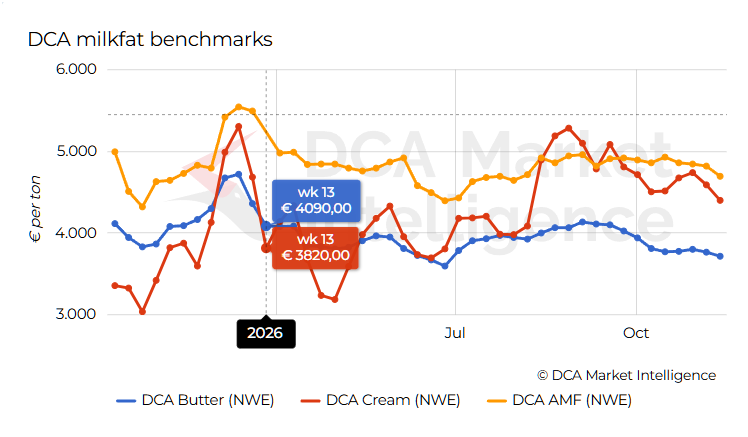
European butter prices declined further in November, averaging €3,745 per tonne, down 1.3% from the previous month and nearly 19% below the level seen a year earlier. Other milk fat products also remained under pressure. Cream averaged €4,500 per tonne, while anhydrous milk fat (AMF) reached €4,763 per tonne. Butter experienced the sharpest year-on-year decline within the milk fat complex.
The international market shows a similar pattern. Butter prices on the Global Dairy Trade (GDT) platform fell 4.4% month-on-month and were more than 24% lower than a year earlier. Although European butter remains cheaper than GDT butter, that advantage is narrowing. At the same time, U.S. butter is significantly less expensive, making American exporters increasingly competitive in world markets.
 A key factor behind market developments is milk and milk fat production. European milk deliveries lost momentum during September, particularly in Germany, where milk fat availability fell considerably. The Netherlands and Poland also recorded declines, while Ireland and Denmark continued to expand production. Despite this slowdown, cumulative milk fat availability remained 2.7% above the previous year’s level, indicating that supply is still relatively abundant.
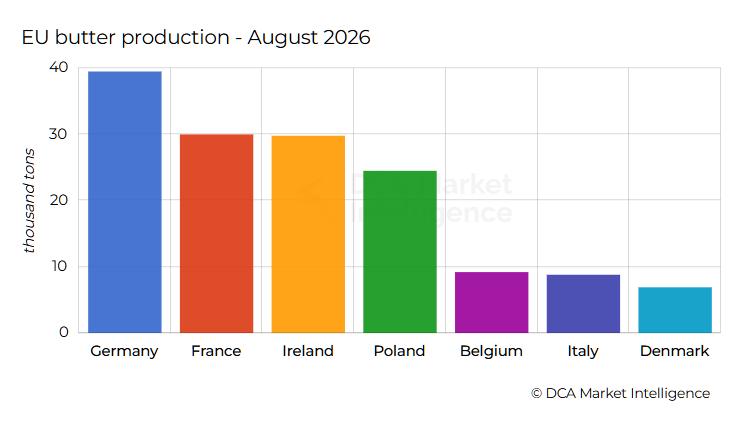
Butter production presents a similar picture. Output during August was largely unchanged compared with the previous year, as growth in countries such as Poland, France, and Germany was offset by declines elsewhere. However, strong increases earlier in the year resulted in EU butter production reaching 1.52 million tonnes between January and August, up 7.4% year-on-year. Germany and Poland accounted for roughly 61% of this increase.
Cream production moved in the opposite direction, falling nearly 5% in August and 1.2% on a year-to-date basis. Nevertheless, much of the cream available in the market continues to be diverted into butter manufacturing, limiting the impact of lower cream production on overall milk fat supply.
Exports have provided important support to the market. EU butter exports to non-EU destinations increased by 39% through August, reaching more than 219,000 tonnes. August exports alone were about 45% higher than the previous year. However, export revenues increased by only 5%, as butter prices fell sharply. In other words, Europe is selling much larger volumes but earning considerably less per tonne.
The structure of exports is also changing. Bulk butter shipments have grown much faster than retail-packed butter, reflecting stronger demand from industrial users. Ireland remains the largest non-EU butter exporter, while France and Germany have also strengthened their positions. AMF exports rose by 48%, led primarily by the Netherlands.
Demand growth has been concentrated in a few key markets. The United Kingdom and Turkey were the main drivers of export expansion, while U.S. imports declined slightly. For AMF, Saudi Arabia and Indonesia emerged as particularly important growth destinations. Within Europe, Poland is becoming an increasingly significant processing and trading hub for milk fat products.
 Despite stronger exports, overall market conditions remain difficult. High production during the first half of the year created substantial surpluses that have not yet been fully absorbed. Although butter availability fell below year-earlier levels during July and August, inventories remain elevated.
The competitive environment is another concern. U.S. butter production continues to rise and American stocks have increased significantly. With lower prices, U.S. suppliers are well positioned to capture market share in destinations such as Saudi Arabia and South Korea. New Zealand, meanwhile, is entering its seasonal production peak and is also offering increasingly competitive prices.
Overall, the report concludes that the sharp decline in European butter prices may be slowing, but the conditions for a sustained recovery are not yet in place. Lower milk deliveries and expected reductions in butter production could gradually reduce supply pressure. However, high inventories, strong competition from the United States and New Zealand, and continued profitability in production suggest that any significant price increase remains unlikely in the near term. Further price weakness cannot be ruled out.