In a recent article, the trade journal *Boerderij* examines the various milk streams in the Netherlands. Dairy farmers can significantly increase their milk price by switching to a suitable milk stream – that is, a specific marketing concept with particular sustainability, quality or production requirements. The potential premiums range from 3c to 10c per litre for conventional special programmes up to 21c to 25c per litre for organic milk. Given the structural decline in milk production in north-western Europe, competition is growing among dairies, which are actively courting new suppliers. For farmers, this opens up new opportunities, but also makes it necessary to choose the right milk stream carefully and on a case-by-case basis.
Falling milk volumes, increasing competition
Milk production in north-western Europe has been declining for years. The reasons for this include stricter environmental regulations, limits on livestock numbers, a shortage of land, and policy measures to reduce emissions. As a result, dairies are competing more fiercely for raw milk. Milk supplies with a sustainability profile are in particularly high demand, as these are becoming increasingly important to retailers and international buyers.
Common criteria for premium payments include:
Grazing (full or partial)
Energy efficiency and CO₂ reduction
Animal welfare programmes
Biodiversity measures
GMO-free feed (VLOG)
A2 milk
Climate-friendly housing concepts
Organic production
Farmel, an independent milk marketer, confirms that farmers are switching suppliers more frequently today than they did ten years ago – simply because there is more choice and more dairies are open to new suppliers.
Flynth has compared the price premiums for various programmes:
3–10 cents per litre for conventional special schemes
21–25 cents per litre for organic milk
These additional revenues are substantial and, over the years, can make the difference between a financially stable farm and one under financial strain. However, advisers warn against making sweeping generalisations: every farm is unique, and actual profitability depends on individual key performance indicators.
The major Dutch dairies and their schemes
FrieslandCampina
Basic requirements via Foqus Planet
Sustainability premium of up to €4/100 kg
PlanetProof: €5/100 kg, but no Foqus premium
Organic: currently around €21/100 kg more than conventional
PlanetProof is regionally limited and dependent on market demand.
A ware
1,800 suppliers, 75% in specialist programmes
No membership capital required
Six milk streams, including Koe Bewust (premium of €6.66/100 kg)
Beter voor: particularly suitable for more extensive farms
A ware sees strong market momentum and a high rate of switching.
Vreugdenhil Dairy Foods
Three sustainability programmes
Premiums of up to €5/100 kg
Tomorrow’s Dairy (with Nestlé): focus on regenerative agriculture
Organic: currently €25/100 kg above conventional prices
Farmel
Works with various buyers
Growing demand for PlanetProof
Seeking new suppliers for sustainable programmes
Organic milk: rising demand
FrieslandCampina, A ware and Farmel currently have no waiting lists for the switch to organic production. Organic milk prices are significantly higher than those for conventional milk, although the difference varies depending on the market phase. A ware is planning a new organic concept and is looking for additional organic milk.
ABN Amro expects the supply of organic milk to grow as larger conventional farms take part in government buy-back schemes.
Dynamics and future of milk flows
The market for specialised milk is developing rapidly. Within the Berlin–Paris–London ‘triangle region’, there is considerable potential for new concepts. Requirements are regularly updated, and programmes are discontinued or launched. Farms that get in early usually benefit the most until a programme becomes the norm.
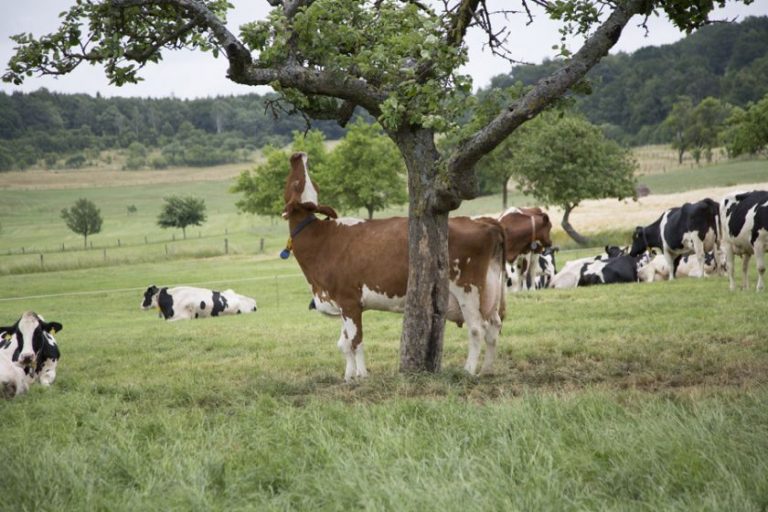
Photo: Arla