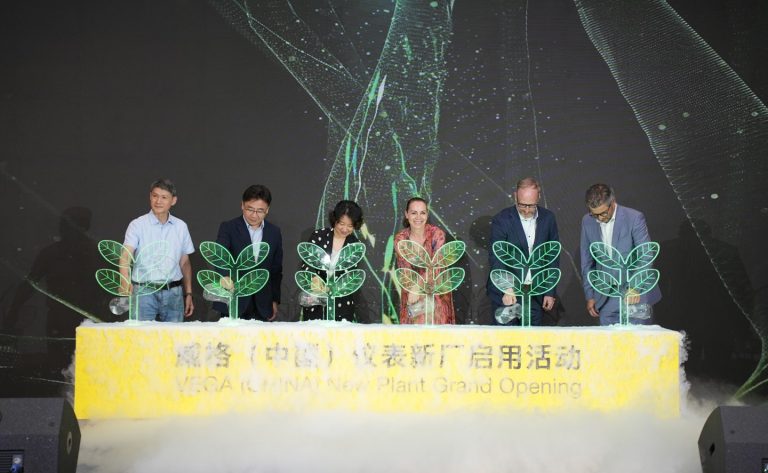
The new plant in Jiaxing was officially opened at the end of May. In attendance were Managing Partner Isabel Grieshaber (third from the right), Managing Director Markus Kniesel (second from the right) and Christoph Siegel (on the right), who is responsible for Sales, Customer Services, Product Management, Information Management and IT at VEGA in Schiltach (photo: VEGA Grieshaber)
Instrumentation manufacturer VEGA Grieshaber KG, based in Schiltach, Germany, continues to expand its international presence. At the end of May, the company commissioned and festively inaugurated a new production facility in Jiaxing, China. Following the expansion of its electronics manufacturing in the USA in October 2025, the company is now strengthening its global production strategy and laying the foundation for further growth. Production at the headquarters in Schiltach will continue, supplemented by the new plant.
VEGA has been active in the Chinese market for 37 years already. The newly constructed building in Jiaxing comprises approximately 21,000 square metres of production, storage and office space. The facility accommodates around 180 employees.
The start of production was preceded by several years of intensive planning. Construction was completed on schedule: It began in December 2024 and went smoothly, allowing the entire project to be finished according to plan. The plant is located in a rapidly growing economic and technological development zone in Jiaxing. The official opening was attended by senior management from Schiltach, the entire VEGA China workforce, numerous customers as well as invited guests.
Production for regional markets
The production capacity is designed to meet the needs of the growing Chinese market. The facility adopts manufacturing concepts and technical standards from the headquarters in Schiltach. This enables production of customer-specific products, optimised inventory management and automated quality control. Local production allows VEGA to respond more quickly to the demands of the local market, shorten delivery times and reduce logistics-related CO₂ emissions. At the same time, local production enables a more flexible technical support for customers in the region.