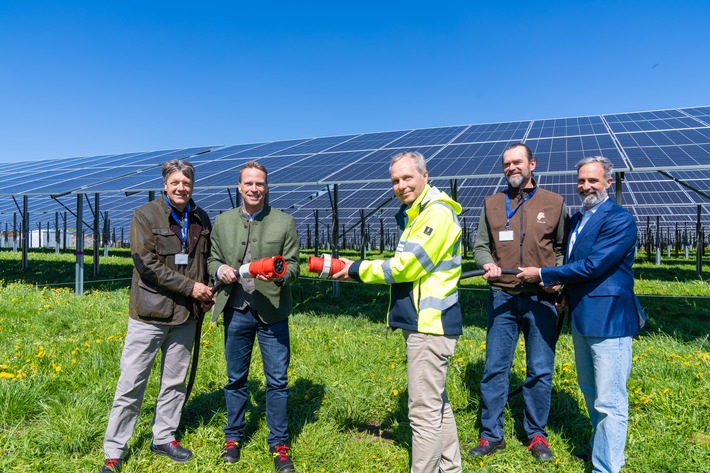
From left to right: Stephan Sedlmayer, President of the Bavarian State Institute for Agriculture; Alexander von Maillot, CEO of Nestlé Germany; Frank Brinkmann, Plant Manager at Biessenhofen; Gerhard Metz, farmer; Stephan Schindele, BayWa r.e. (Photo: Nestlé)
Nestlé has commissioned an innovative agri-photovoltaic system at its plant in Biessenhofen, Germany. The ‘Cow-PV’ system combines the generation of regional green electricity with agricultural use, hay production and animal welfare.
Nestlé has invested around €3m in the project. The agri-PV plant was built on a 4.74-hectare site in the immediate vicinity of the factory and is directly connected to the production site. With an installed capacity of 4.5 megawatts peak, it can theoretically cover around a quarter of the factory’s electricity requirements.
A distinctive feature of the system is its concurrent agricultural use: the land remains pasture and forage land for cows. The PV system’s modules are mounted on 2-metre-high support structures. This provides shade for the cows and shelter in the event of rain. A total of 7,800 solar modules have been installed. The 3.30-metre spacing between the rows of PV modules ensures that the land can still be worked using a tractor, mower and forage wagon. Whilst Nestlé invested in the agri-PV system, a farmer has built a new barn on the site.
The new barn, which can accommodate up to 50 cows, is located directly adjacent to the area with the photovoltaic system and is equipped with automated milking technology. It allows the animals to graze, a prerequisite for organic farming.