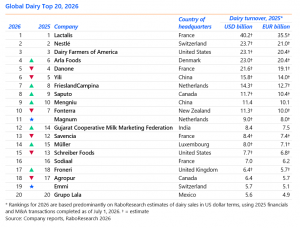
 The world’s 20 largest dairy companies increased their combined turnover by 5.4% to USD 267 billion in 2025, according to a new report from RaboResearch. The latest Global Dairy Top 20 ranking shows that consolidation continues to reshape the industry, with leading companies increasingly focusing on specialized, higher-value business models alongside the benefits of scale. Lactalis maintained its No. 1 spot, and two new entrants made their Top 20 debut.
Consolidation remains a defining trend
Mergers, acquisitions, and portfolio reshaping continued to transform the global dairy industry in 2025 and 2026. Major transactions, including the merger between Arla Foods and DMK Group, FrieslandCampina’s merger with Milcobel, and Lactalis’ acquisition activity, underscore the growing importance of scale and investment capacity in an increasingly competitive market.
“The global dairy industry is entering a new phase defined by consolidation, specialization, and a greater focus on value creation,” says Lucas Fuess, Senior Dairy Analyst at RaboResearch. “Companies increasingly view scale as a prerequisite for long-term competitiveness.”
Lactalis extends its lead at the top
Lactalis retained its position as the world’s largest dairy company in 2025, with dairy turnover exceeding USD 40 billion. A series of acquisitions, including Fonterra’s Mainland Group consumer business in Australia and Asia and General Mills’ US yogurt business, helped widen its lead over second-placed Nestlé to more than USD 16 billion.
The top three companies in the ranking remained unchanged. Nestlé retained second place, despite reducing dairy’s relative importance within its broader food and beverage portfolio. Third-ranked Dairy Farmers of America expanded through targeted investments in value-added processing, particularly in specialty cheese.
Arla-DMK merger reshuffles the ranking
One of the biggest changes this year came from the merger of Arla Foods and DMK Group, which created Europe’s largest dairy cooperative and propelled the combined business into the top five (at No. 4). “We have seen a broader trend toward consolidation among dairy cooperatives seeking scale to remain competitive in an increasingly globalized dairy market,” notes Fuess.
The merger also opened the door for change elsewhere in the ranking. Switzerland’s Emmi entered the Top 20 in 19th position. Meanwhile, Unilever exited the list, no longer qualifying as a dairy company after separating its ice cream division into The Magnum Ice Cream Company, which made a tremendous Top 20 debut at No. 11.
China’s dairy giants Yili (No. 6) and Mengniu (No. 9) remain among the world’s largest dairy processors, but both are navigating a more mature domestic market. As growth opportunities from volume expansion become harder to find, the companies are increasingly focused on premiumization, innovation, operational efficiency, and higher-value products.
While strategy and M&A activity were the main drivers of ranking changes, milk prices and currency movements also continued to influence reported revenues across regions.
Growth increasingly comes from value creation
Across the sector, growth is increasingly being driven by higher-value segments, including nutrition, protein ingredients, specialty cheeses, and functional dairy products. Companies are investing in categories where they can build stronger market positions and differentiate themselves from competitors.
“We are seeing several companies move toward more specialized business models, including Fonterra’s increasing focus on ingredients and foodservice, plus the rise of category-focused businesses such as ice cream specialists Magnum and Froneri,” Fuess says. “Future success will depend less on diversification and more on establishing leadership positions in targeted segments.”.
Scale and focus will shape the next phase of growth
Looking ahead, RaboResearch expects consolidation to continue as dairy companies seek larger milk pools, stronger balance sheets, and greater investment capacity. “Scale will remain important,” says Fuess, “but differentiation through brands, ingredients, nutrition, and innovation will become increasingly critical.”
He concludes: “In the coming years, we expect to see fewer but larger dairy companies controlling a greater share of global milk production. Those that successfully combine size with innovation, differentiation, and value-added product offerings are likely to be best positioned for long-term success.”.