St. Paul Group, a producer of processed cheese and cheese alternatives and parent company of Koninklijke ERU, introduces Tasty Melt Hybrid. This tailor-made hybrid cheese matrix combines dairy and non-dairy raw materials to give food manufacturers the authentic functionality of cheese, but with a significantly lower carbon footprint. The official launch will take place at SIAL Paris [17–21 October], where the product has been honoured with a SIAL Innovation Award.
Meeting CSRD targets without compromising on the end product
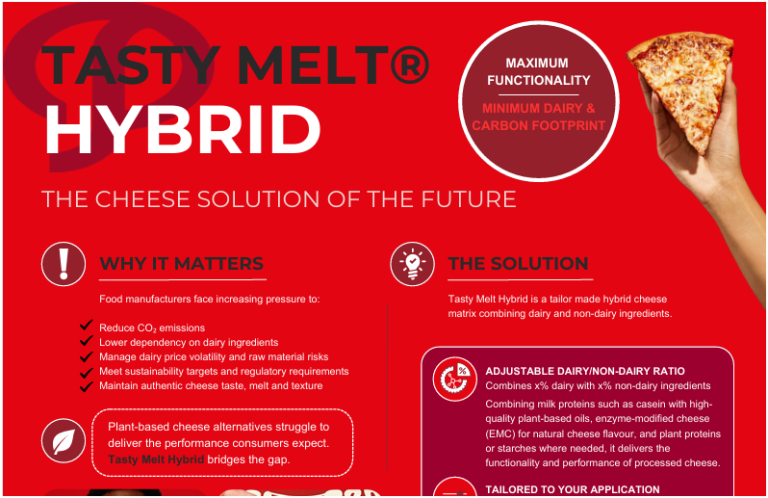
Food manufacturers are under increasing pressure from the European Green Deal and the Corporate Sustainability Reporting Directive (CSRD) to reduce emissions. At the same time, fully plant-based cheese alternatives often fall short in terms of melt behaviour, texture and taste. Tasty Melt® Hybrid bridges this gap by combining milk proteins with high-quality plant proteins.
“The food industry is caught between tough sustainability targets and consumers who refuse to compromise on the taste and meltability of their pizza or cheese snack,” says Dieter Kuijl, CEO of St. Paul Group. “Fully vegan alternatives often fail to perform functionally on the production line. With Tasty Melt Hybrid, we are building a realistic bridge: we retain the industrial performance of dairy while drastically cutting CO₂ emissions. It is not a replacement, but a necessary enhancement.”
Double SIAL Innovation Award confirms leadership in hybrid dairy
The innovation is part of the group’s broader strategic focus on hybrid dairy. In early September, subsidiary Koninklijke ERU successfully launched ERU Hybrid Gouda Spread, a hybrid cheese spread containing just 40% dairy, with the trusted ERU taste and 40% lower CO₂ emissions. Both products have won a SIAL Innovation Award, underlining the rapid uptake of, and market demand for, high-quality hybrid solutions.
Measurable CO₂ reduction without process changes
The ratio of dairy to non-dairy ingredients in the Tasty Melt® Hybrid matrix can be adjusted for each application. A case study involving hybrid mozzarella (made up of 79% non-dairy and 21% dairy ingredients) shows a 57% reduction in CO₂ emissions compared with 100% dairy mozzarella, based on data from the Dutch National Institute for Public Health and the Environment (RIVM). The hybrid solution is scalable, with no need for manufacturers to modify their existing processes or equipment, whether ovens, grills or fryers.
Official launch at SIAL Paris
Visitors to SIAL Paris can taste both award-winning innovations and explore the business opportunities for their own production lines at Stand B256, Hall 7. Beyond the show, Tasty Melt Hybrid is available with immediate effect to the European B2B market in a range of industrial formats.
Tasty Melt Hybrid – infographic