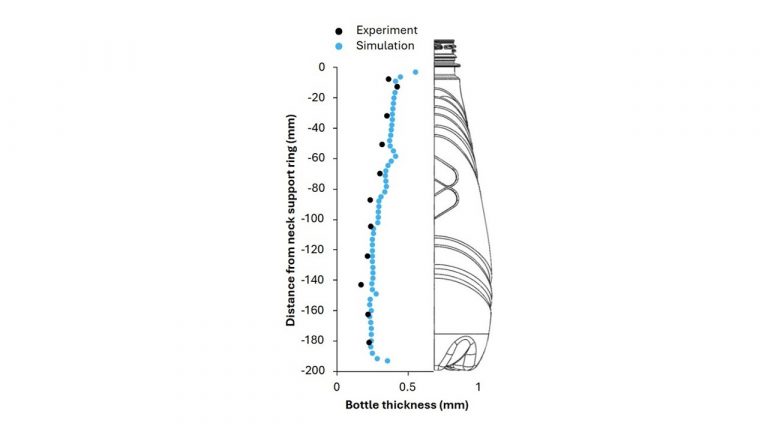
BMT, a strategic partner to the global packaging industry, has developed precise-forming simulation method, designed to support beverage producers wanting to accurately predict the wall thickness of PET and rPET bottles. The methodology combines BMT’s simulation-driven approach with advanced material characterisation, enabling reliable virtual performance testing of “as-manufactured bottles” under real-world conditions.
Material characterisation shows how the resin behaves when it is heated, stretched and shaped, giving the simulation the accurate inputs it needs to predict how the bottle will form. This includes biaxial tensile testing, which measures how the material responds when stretched in two directions under controlled conditions. These tests capture deformation patterns, stretch ratios, stiffness changes and how processing history influences mechanical behaviour.
Simulation takes the measured material data and uses it to model the full bottle‑forming process. Instead of relying on constant wall thickness or uniform stiffness, BMT’s approach predicts how the material stretches in both the hoop and axial directions and how it distributes throughout the bottle during blowing. This produces a thickness and stiffness profile that reflects what is seen in physical bottles.
BMT runs virtual top load and burst pressure assessments that predict how the bottle is likely to perform in real‑world testing. In a recent validation study, models using variable properties from the forming behaviour matched physical testing within about 1%. In contrast to this, constant‑property models overpredicted performance by 13% and up to 63%, demonstrating how simplified assumptions can mislead design decisions.